A mortgage buydown can reduce what you pay each month, but temporary assistance and a permanent rate reduction work differently. Compare the payment after any subsidy ends, the upfront cost, and the cash remaining after closing. For a Ruskin home purchase, the option should fit the property’s full ownership budget without depending on a future refinance.
A temporary buydown uses funds set aside to cover part of your scheduled payment for a limited time. On a fixed-rate mortgage, the contractual interest rate, called the note rate, remains unchanged. Your share increases as the subsidy decreases.
Under Fannie Mae’s temporary buydown requirements, the lender qualifies the borrower at the note rate. The lower initial payment does not substitute for that qualification. Ask your lender which program requirements apply to your actual loan.
Your own comfort limit deserves a separate review. Include property taxes, homeowners insurance, mortgage insurance when applicable, and association charges. Confirm whether recurring assessments are already included in the lender’s estimate so you count them once.
If the full payment feels unworkable, early relief should not be the reason to choose a more expensive home. We can use a lender-reviewed budget to narrow the search before you negotiate financing assistance.
Consider a hypothetical $417,000 purchase with $12,510 down and a $404,490 loan over 30 years. At a 7.20% fixed note rate, monthly principal and interest are approximately $2,746 before other housing expenses.
With a 2-1 temporary buydown, the buyer’s principal-and-interest portion is calculated as if the rate were 5.20% in year 1 and 6.20% in year 2. The note rate remains 7.20%. Rounded monthly figures are:
Funding those payment differences costs approximately $9,513 over 24 months. That is prepaid assistance distributed over time, not interest savings created by changing the note rate.
For comparison, a hypothetical permanent reduction to 6.58% produces principal and interest of about $2,578, approximately $168 less monthly than the 7.20% loan. The example assumes a $9,998 upfront cost for that rate. It does not establish that a lender would offer 6.58% for that amount.
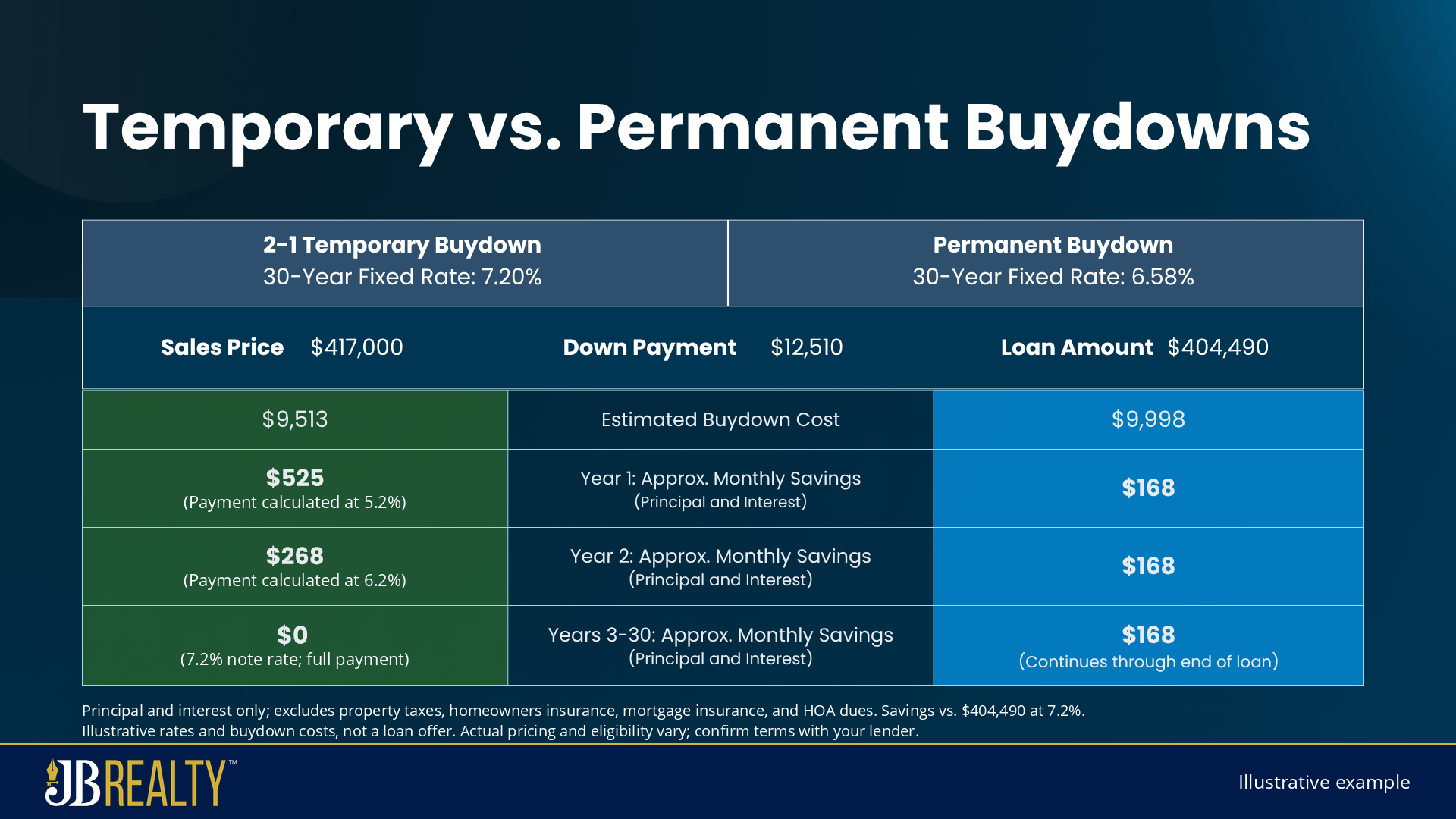
All figures exclude taxes, insurance, mortgage insurance, and association charges. The down payment is also separate from buydown funding and other closing expenses. Request a complete estimate for the specific property before treating the payment as your ownership budget.
A permanent buydown generally pays discount points at closing for a lower contractual interest rate. That benefit lasts while you keep the mortgage; a replacement loan has its own terms.
The Consumer Financial Protection Bureau’s explanation of discount points and lender credits states that 1 point equals 1% of the loan amount. On the hypothetical $404,490 mortgage, 1 point is $4,044.90. There is no universal rule that buying 1 point reduces the rate by a quarter of a percentage point.
Ask for comparable written offers with and without points. Keep the loan amount, term, program, and rate-lock assumptions consistent, and compare offers prepared close together. A lower advertised rate may carry a different upfront cost.
Our guide to comparing mortgage quotes explains how to review fees, credits, payment estimates, and cash due at closing together. Use that full comparison before deciding which rate is better for you.
Seller or builder funding may make a buydown possible, but assistance must be negotiated and permitted by the lender. Confirm the allowed amount, intended use, and conditions in writing. An advertised incentive does not establish that you qualify for every financing option attached to it.
Ask the lender to compare using available assistance for eligible closing expenses versus buydown funding. If you need more cash to complete the purchase, directing the entire credit toward payment relief may leave that immediate need unresolved. Keep a household reserve in the comparison.
The home’s price matters as well. A higher purchase price offered in exchange for a credit can affect the loan amount and appraisal review. We can help compare the property and proposed purchase terms while your lender confirms the usable assistance.
For borrower-paid permanent points, a simple starting calculation divides the additional upfront cost by the monthly payment reduction. Using the example’s $9,998 cost and roughly $168 monthly benefit gives about 60 months to recover that cost through payment savings.
That calculation does not compare the permanent option with the 2-1 subsidy. It also excludes differences in remaining loan balances, the use of your cash elsewhere, and other financial effects. If a seller supplies the credit, review its available alternative uses instead of treating the entire amount as cash you personally paid.
Compare a shorter holding period, your most likely timeline, and a longer stay. Selling or refinancing earlier can change the value of paying points, but a planned refinance is uncertain. Future rates, credit, income, property value, and new loan costs all need to support it.
Our article on building a homebuying budget that allows for change explains why the purchase should remain workable when one assumption changes. Apply that same approach to any payment incentive.
On the fixed-rate arrangement described here, it subsidizes payments without changing the note rate. Your portion increases in year 2 and reaches the full payment in year 3. Ask for the written schedule before committing.
For loans following Fannie Mae’s temporary buydown rules, qualification uses the note rate. Have your lender review the applicable program rather than using the subsidized payment to set your search limit. Approval and personal affordability also deserve separate consideration.
No. The rate benefit depends on the lender, loan, and pricing available at the time. Compare written alternatives rather than applying a fixed rate discount to the number of points.
The written agreement and applicable program rules govern their treatment when the loan is paid off. Do not assume the money is automatically returned to you or the seller. Have the lender explain those provisions before closing.
Compare the permitted uses with your immediate cash requirement, future payment, and reserve. The better allocation depends on the actual loan offer and your budget. Have the lender confirm eligibility and show both outcomes.
Bring us the lender’s payment schedule and cash-to-close estimates, and we can help compare homes and negotiate purchase terms around the financing plan you can comfortably carry.