
The latest expert survey’s average forecast favors continued national home-price growth through 2030, rather than a broad housing crash. That does not rule out declines in particular markets or homes. For Tampa Bay buyers, the useful question is whether a specific property fits your budget and plans without relying on appreciation, lower future mortgage rates, or a quick resale.
Before deciding to wait for a price drop, test whether homeownership would work if the home’s value stayed flat. Start with the total monthly payment, cash needed to close, reserves for repairs, and how long you realistically expect to keep the property. A purchase that requires rapid appreciation to become comfortable deserves another look.
Florida ownership costs deserve a property-specific review. Obtain insurance quotes, check flood information through FEMA, and confirm property-tax estimates with the county property appraiser. Include any HOA dues, condominium charges, and community development district, or CDD, assessments that apply.
A single-family home in Riverview and a condo in St. Petersburg can have different expense structures even at similar purchase prices. For the condo, review the association budget, reserves, and assessments alongside the unit itself. Our guide to comparing mortgage rates and the full cost of a purchase explains how to keep the payment and upfront cash in the same comparison.
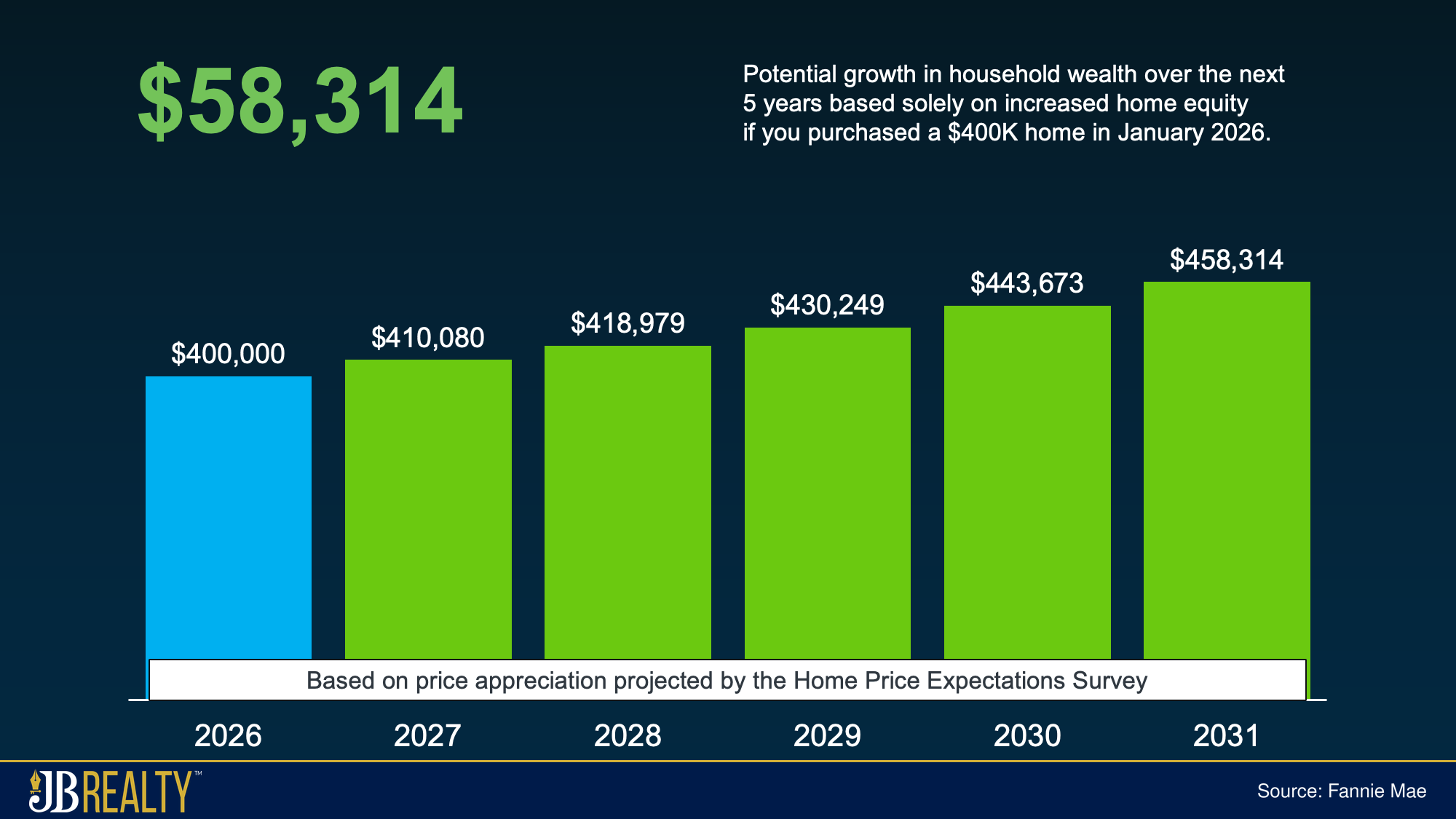
The $400,000 example starts with a hypothetical purchase in January 2026 and applies five annual appreciation assumptions. Its projected value reaches $458,314 at the final step labeled 2031. That $58,314 difference is conditional home-value growth, not a promised financial result.
The starting date matters. This is an illustration built from a January 2026 baseline, so it should not be treated as a new five-year projection for someone buying today. The actual home, purchase price, and future market conditions could produce a different result.
Equity is the home’s value minus the outstanding loans secured by it. Paying down principal can increase equity separately from appreciation, while selling expenses reduce the cash an owner receives at closing. Insurance, maintenance, taxes, and borrowing costs also matter when evaluating the overall financial outcome.
Consider the downside too: a hypothetical 5% decline would reduce a $400,000 home’s value to $380,000. That is a $20,000 value change before considering the loan balance or selling costs. This is a planning scenario, not a prediction, and it highlights why cash reserves and flexibility about when to sell matter.
Fannie Mae’s Home Price Expectations Survey, produced with Pulsenomics, gathers forecasts from more than 100 housing experts. It measures expectations for national price changes, so its results provide context rather than a valuation for a particular address.
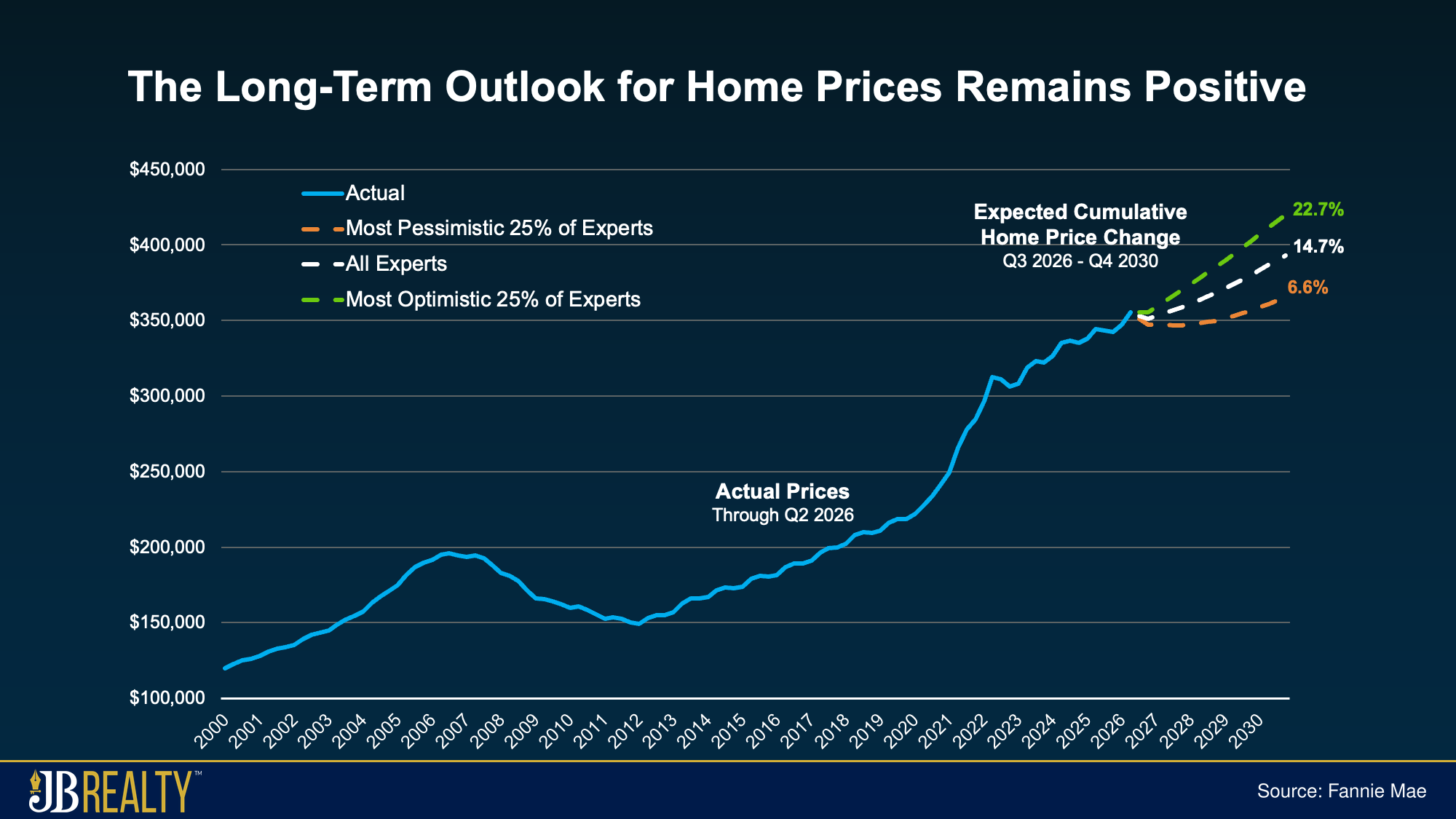
The longer-term forecast paths put cumulative growth from Q3 2026 through Q4 2030 at 14.7% for the full panel, compared with 6.6% for the most pessimistic quarter and 22.7% for the most optimistic quarter. Those percentages describe forecast groups, not a return promised to an individual owner.
A positive average for the pessimistic group does not mean every participant expects prices to rise. Nor does positive national growth prevent a particular community, building, or property from losing value. Use the range to understand uncertainty rather than treating the average as a reason to stretch your budget.
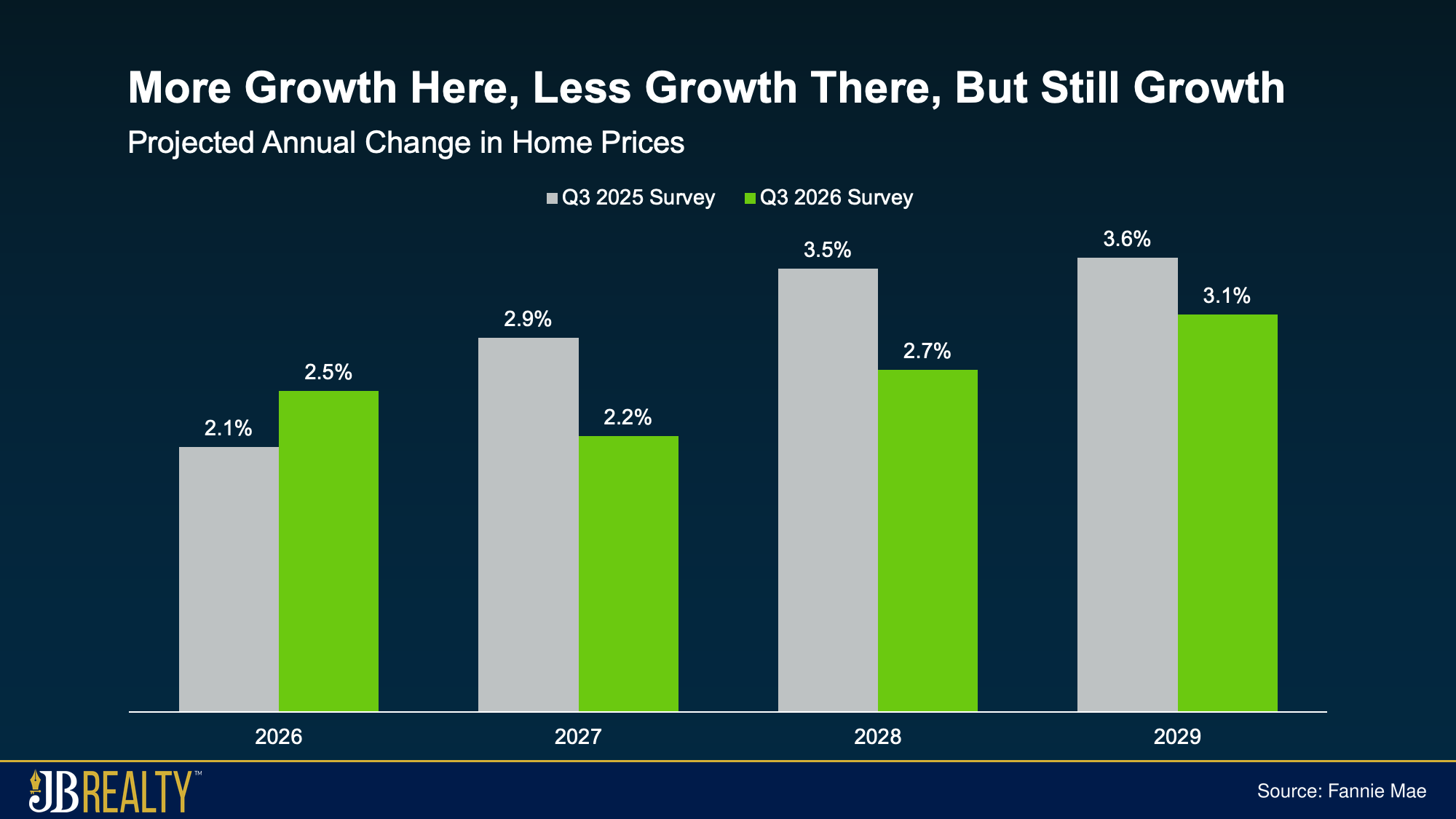
The comparison between the Q3 2025 and Q3 2026 surveys also shows expectations changing. The 2026 estimate rose from 2.1% to 2.5%, while the 2027 estimate fell from 2.9% to 2.2% and the 2028 estimate fell from 3.5% to 2.7%. The 2029 estimate also declined from 3.6% to 3.1%.
These revisions illustrate why a forecast should inform a plan without controlling it. Recheck the property, financing, and local competition when you are ready to make an offer instead of assuming an earlier outlook still answers today’s buying question.
Florida Realtors’ August 2026 metro report recorded a $410,000 single-family median sale price in the Tampa-St. Petersburg-Clearwater metro, up 2.5% from August 2025, while closed sales fell 7.6%. The condo-townhouse median was $274,000, up 4.1%. These figures describe completed transactions, rather than predicting the next sale.
The median can change because the mix of homes sold changes, even when individual property values move differently. The metro also covers four counties, so its results cannot establish the right offer for one street or building. Compare recent similar sales, active alternatives, condition, and price changes before choosing terms.
Our explanation of Tampa Bay buyer negotiating leverage shows how to move from a broad market label to a property-specific comparison. Waiting may make sense if your payment would be strained, your reserves are thin, or your ownership plans are uncertain. If you wait, set concrete readiness targets and revisit current options rather than making a crash your only trigger.
The survey discussed here forecasts national prices and does not provide a Tampa Bay crash prediction. Its group averages are positive, but local outcomes can differ. Evaluate the property and current local evidence rather than assuming the national forecast settles the question.
Yes. National results combine markets that can move in different directions. Within the same metro, property type, condition, ownership expenses, and competing inventory can also produce different outcomes.
There is no dependable forecast that tells you when a particular home will become affordable. Waiting can be sensible when your finances or plans need more preparation. A workable purchase should fit current costs without requiring a price rebound or future refinance.
No. That figure describes a cumulative national forecast, not an annual rate or a property-specific promise. Your home’s actual value could rise by a different amount, remain flat, or decline.
No. Appreciation changes estimated value, while equity also depends on outstanding debt. Net sale proceeds and overall profit require accounting for transaction expenses and other relevant costs, which the value-growth example does not calculate.
Through our Tampa Bay buyer representation, we can help you compare current competition and recent sales for the homes you are considering. Ask JB Realty to review those options alongside your payment, cash reserves, and moving timeline before deciding to buy now or wait.