
Higher mortgage rates can increase active housing inventory, but not because they create more homes. When financing costs reduce buyer demand, listings may take longer to sell and accumulate. At the same time, higher rates can discourage owners with low-rate mortgages from moving, so the effect is not automatic. For Tampa Bay buyers, the practical takeaway is to track inventory, days on market, and the complete monthly cost together rather than focusing on rates alone.
Active inventory is the number of homes listed and available at a given time. It can grow because more owners list, fewer homes go under contract, or properties remain on the market longer. Higher borrowing costs often affect demand first because some buyers reduce their budgets or postpone their searches.
That does not mean higher rates create additional housing supply. They can also reinforce the rate-lock effect, which occurs when owners with much lower existing mortgage rates hesitate to sell and replace those loans at current rates. Active inventory may still rise when buyer demand slows more than new-listing activity does, but these forces work against each other.
As of August 13, 2026, Freddie Mac’s weekly mortgage survey placed the average 30-year fixed mortgage rate at 6.67%. That national average is a benchmark, not a Tampa Bay rate quote or guarantee. A buyer’s actual financing costs depend on the loan program, credit profile, down payment, points, property, and lender.
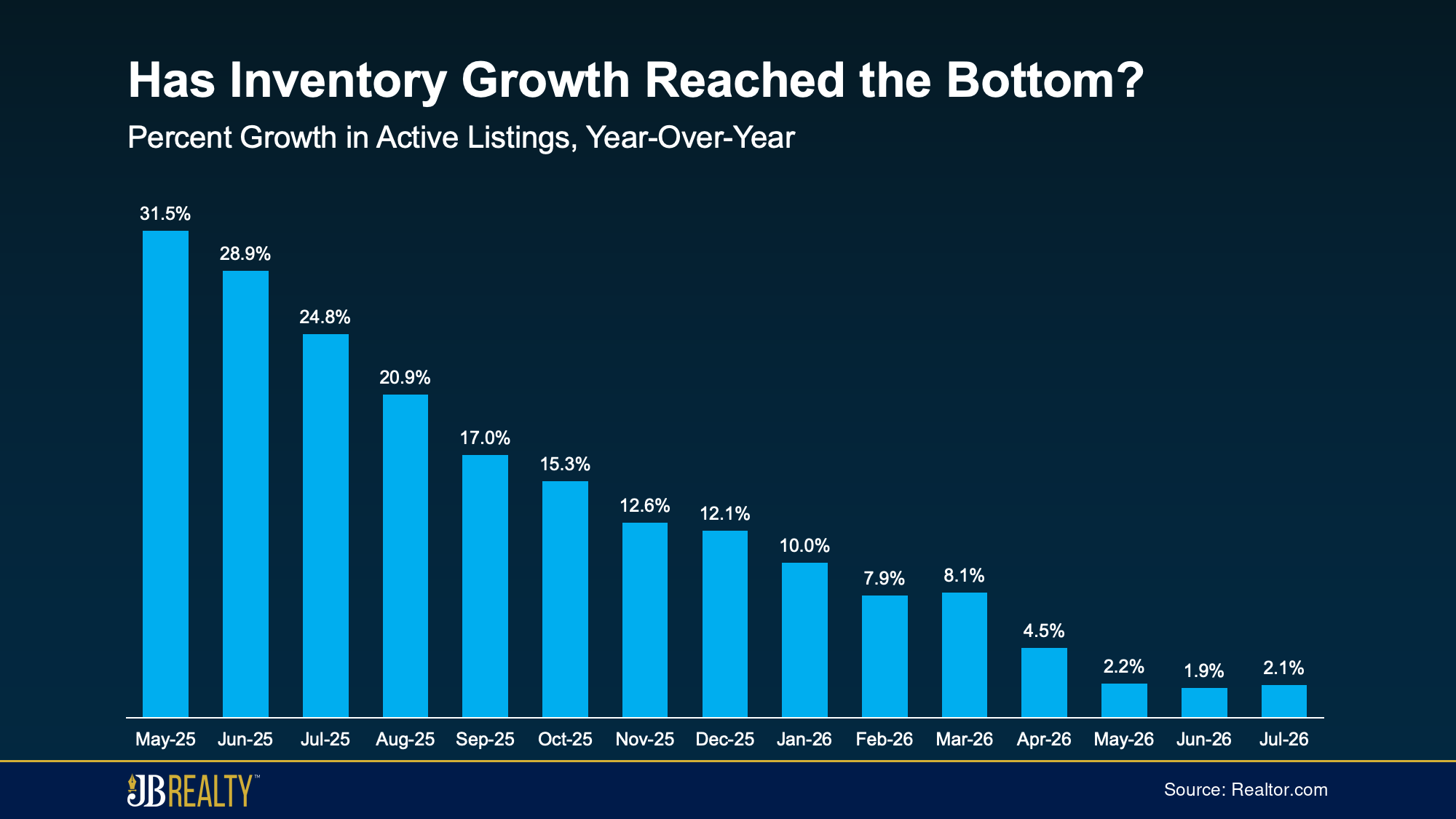
National active listings were 2.1% higher in July 2026 than in July 2025. The first chart places that gain in context: annual inventory growth slowed from 31.5% in May 2025 to 2.1% in July 2026. A smaller positive growth rate still means more homes were available than one year earlier.
The May, June, and July 2026 readings were 2.2%, 1.9%, and 2.1%, respectively. That recent leveling-off is why the slowdown may be finding a floor instead of turning immediately into a broad inventory decline.
For buyers, slower growth can still provide a larger comparison set. However, national inventory does not reveal whether choices are increasing in a particular community, price range, or property type.
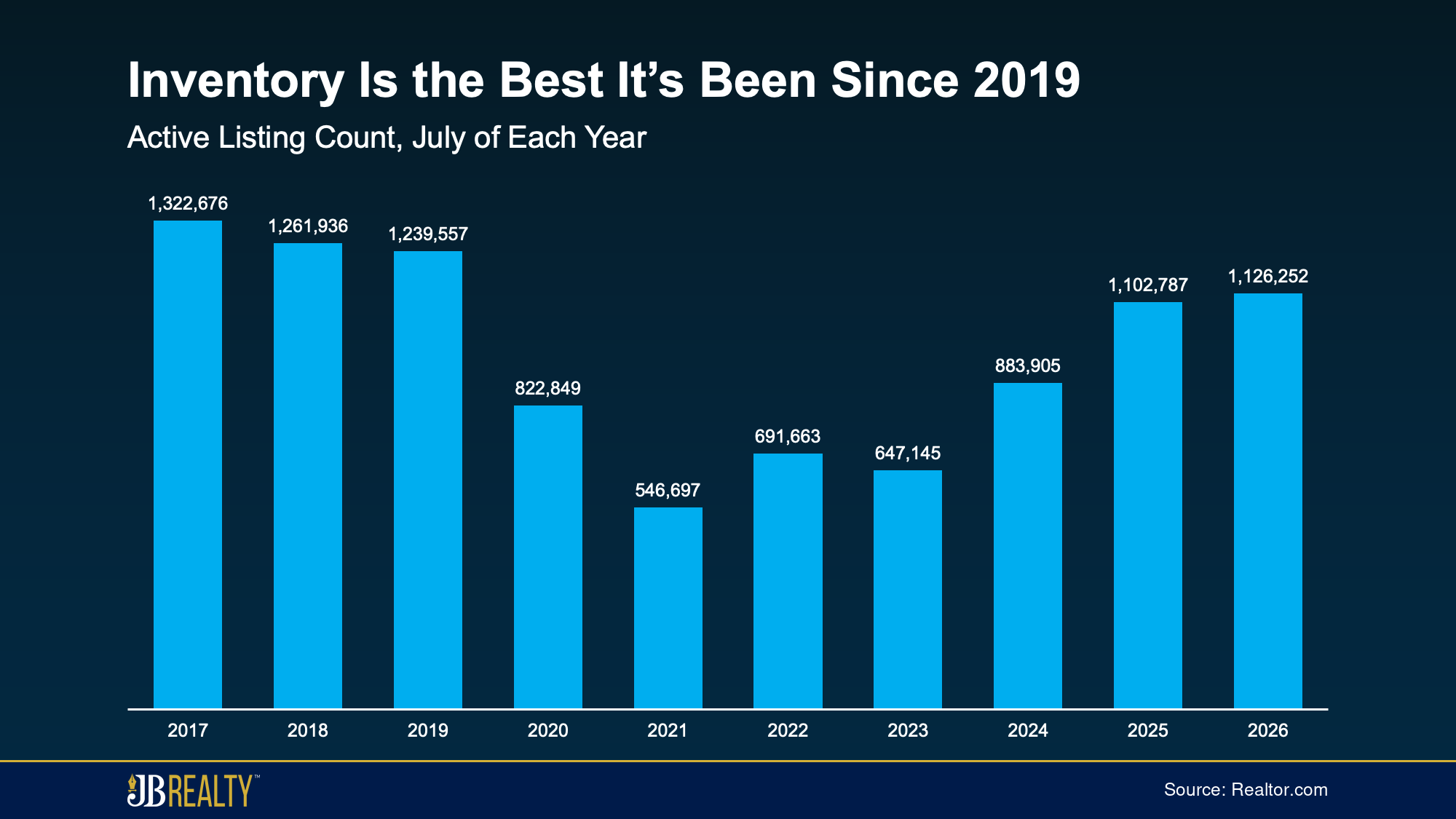
The second chart compares active listings during July of each year. The 1,126,252 homes available nationally in July 2026 represented the highest July total since 2019 and more than twice the July 2021 count. That is meaningful progress, but it is not a complete return to the pre-pandemic inventory benchmark.
Local data demonstrates why geography matters. The Tampa-St. Petersburg-Clearwater active-listing series recorded 18,292 active single-family and condo or townhome listings in July 2026, up from 18,022 in June. The series excludes pending properties, and a one-month increase does not prove that every local segment is loosening.
A Riverview single-family home may face different competition than a Brandon property in another price range or a St. Petersburg condominium. Buyers should evaluate current listings, recent sales, pending activity, and days on market within the specific segment they are considering.
More inventory can give buyers practical advantages, but leverage comes from having credible alternatives rather than simply seeing a larger number of listings.
More choices should not weaken financial discipline. A current mortgage pre-approval can help establish a realistic price and payment range before touring homes.
Florida buyers should also compare property-specific insurance quotes, flood-zone information from FEMA’s official map, estimated taxes after ownership changes, HOA or CDD fees, and possible condominium assessments. These expenses can make two similarly priced homes carry substantially different monthly costs. Buyers should consult qualified lending, insurance, legal, or tax professionals when specialized advice is needed.
Older listings can deserve particular attention. Our explanation of stale listings and buyer negotiation opportunities covers why extended market time does not automatically indicate a defective home. Any offer should still reflect comparable sales, property condition, competing interest, and the seller’s circumstances.
Instead of trying to predict the perfect combination of rates and inventory, buyers can use a repeatable decision process:
Our Tampa Bay home-buying services can help buyers compare live inventory and evaluate the tradeoffs among properties that fit their goals.
When active inventory grows, buyers may compare more competing homes before making an offer. Pricing, presentation, condition, insurance considerations, and recurring fees can therefore influence how a listing performs.
Owners with low mortgage rates should also compare their expected net proceeds with the realistic payment on a replacement property. Higher rates do not automatically benefit sellers. If inventory is accumulating because demand has slowed, accurate pricing and evidence-based negotiation become more important.
They can increase active inventory when higher payments reduce buyer demand and homes remain listed longer. However, higher rates may also discourage owners with lower existing rates from selling, so the result depends on which effect is stronger.
The Tampa-St. Petersburg-Clearwater metro’s active-listing count increased from June to July 2026. Conditions can still differ substantially between Hillsborough and Pinellas counties and among individual communities, property types, and price ranges.
A rate forecast alone is not a sound reason to buy or wait. Compare the payment available now, the homes currently for sale, possible negotiation opportunities, your timeline, and your financial reserves. Purchase only when the transaction works under current terms.
Not necessarily. Seller flexibility depends on comparable sales, property condition, market time, price changes, competing offers, and the seller’s goals. A well-supported offer is generally more credible than an arbitrary reduction from the asking price.
Compare estimated property taxes, homeowners insurance, flood or wind coverage when applicable, HOA or CDD fees, condominium assessments, utilities, and maintenance. Obtain property-specific documents and estimates because these expenses can vary significantly between homes.
Ask JB Realty to compare the current inventory, likely total monthly costs, and negotiation options for the Tampa Bay homes that fit your search.