
Mortgage rates are influenced by 2 important pieces: the yield on longer-term Treasury securities and the additional margin between Treasury yields and mortgage rates, commonly called the mortgage spread. That spread has improved substantially from its unusually wide 2023 level, which is helping borrowers today. But because it has already moved much closer to its historical range, a major additional drop in mortgage rates would likely require the 10-year Treasury yield to fall too.
For Tampa Bay buyers, that distinction matters. Waiting for the mortgage spread alone to return to normal may not produce the dramatic payment improvement some buyers are expecting.
A 30-year mortgage does not usually behave like a 30-year Treasury bond. Homeowners sell, refinance, pay additional principal, or otherwise repay mortgages before the full 30-year term expires. Because of that shorter effective life and the way mortgage-backed securities are priced, the 10-year Treasury yield has historically been a useful benchmark for understanding movements in fixed mortgage rates.
Mortgage rates and Treasury yields do not move perfectly together every day, but their longer-term relationship is strong. When the 10-year Treasury yield rises, mortgage rates frequently face upward pressure. When Treasury yields decline, mortgage rates often have room to move lower.
That connection is why the 10-year Treasury is one of the most useful numbers to watch when trying to understand mortgage-rate movement.
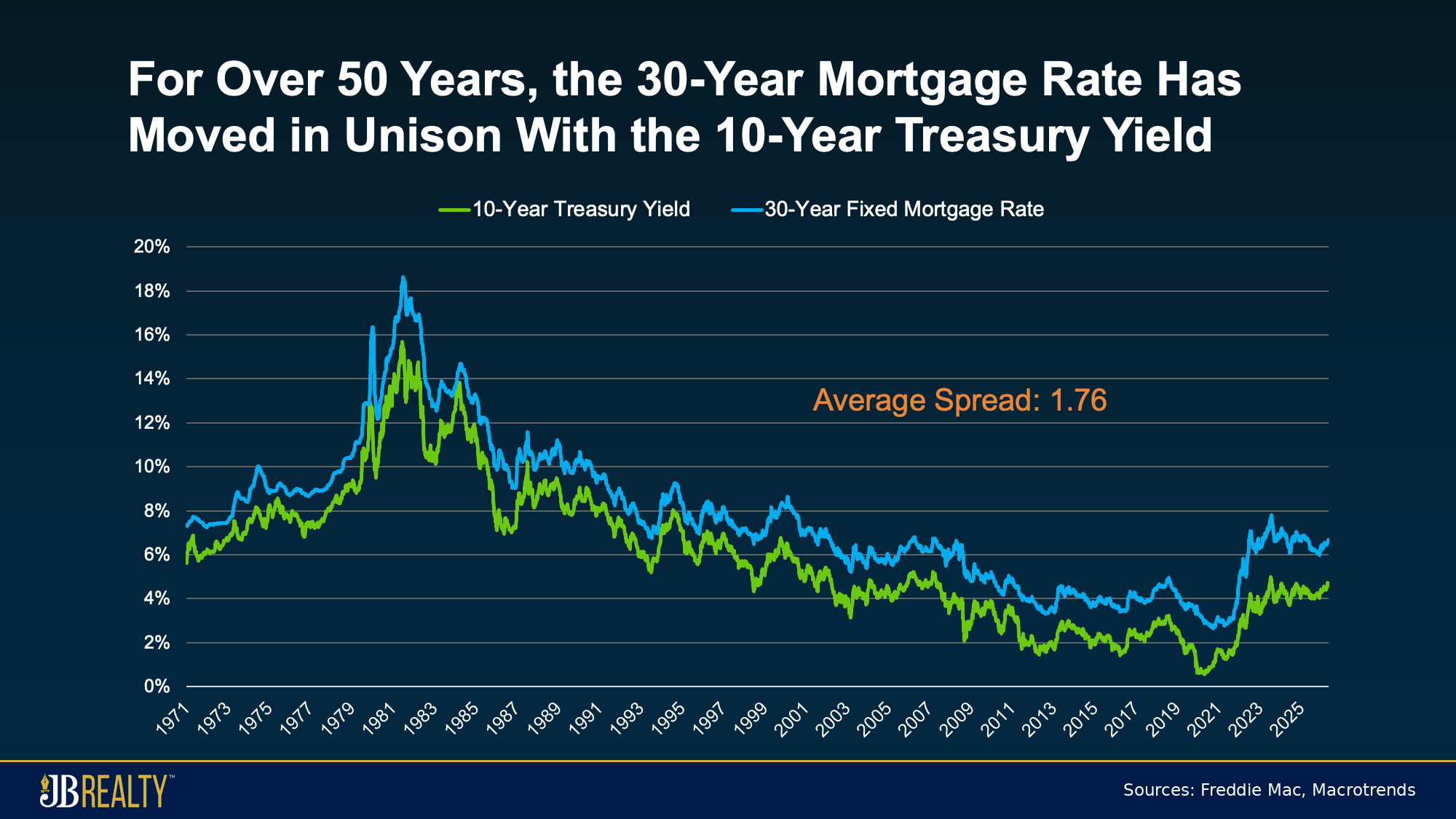
The important point is that your mortgage rate is not simply the Treasury yield. Investors also require additional compensation for the risks and costs associated with mortgages, including prepayment and interest-rate risk. The difference between the mortgage rate and the Treasury benchmark is what we refer to as the spread.
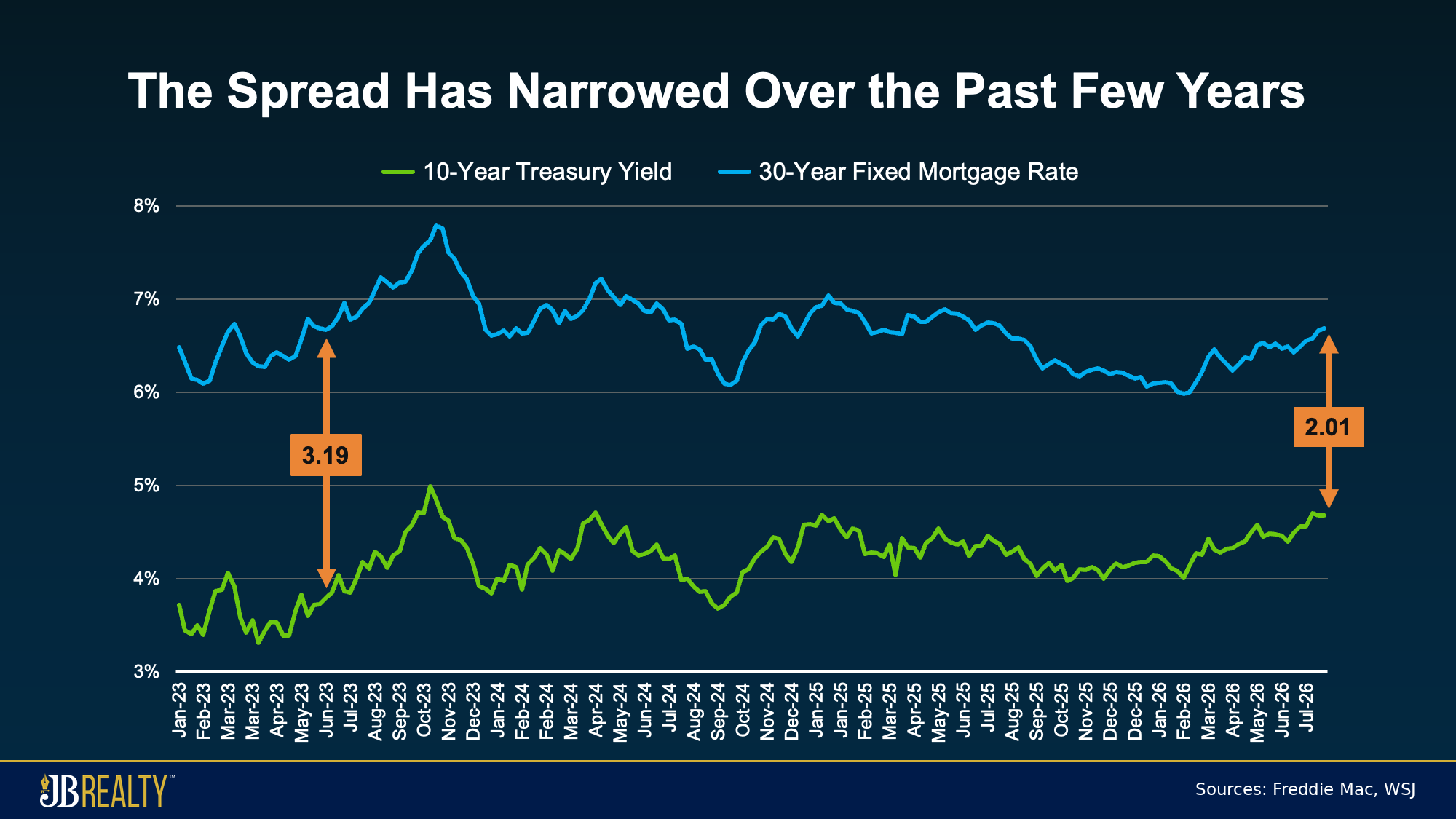
The spread became unusually wide during the economic uncertainty of recent years. The source data for this article shows the gap reaching about 3.19 percentage points in 2023 compared with a long-term average of roughly 1.76 percentage points.
That wider spread mattered. Even if Treasury yields had stayed unchanged, a spread more than 1 percentage point above normal could add significant upward pressure to mortgage rates.
The situation has changed considerably. Freddie Mac’s latest weekly mortgage survey reported an average 30-year fixed mortgage rate of 6.69% as of August 6, 2026. The U.S. Treasury’s daily yield data shows the 10-year Treasury at 4.70% on August 11. Comparing those 2 figures produces a gap of roughly 1.99 percentage points, although the figures come from different measurement periods and should be treated as a simple illustration rather than an exact pricing formula.
That improvement has already helped keep mortgage rates from being considerably higher.
This is where the mortgage-rate conversation gets more interesting.
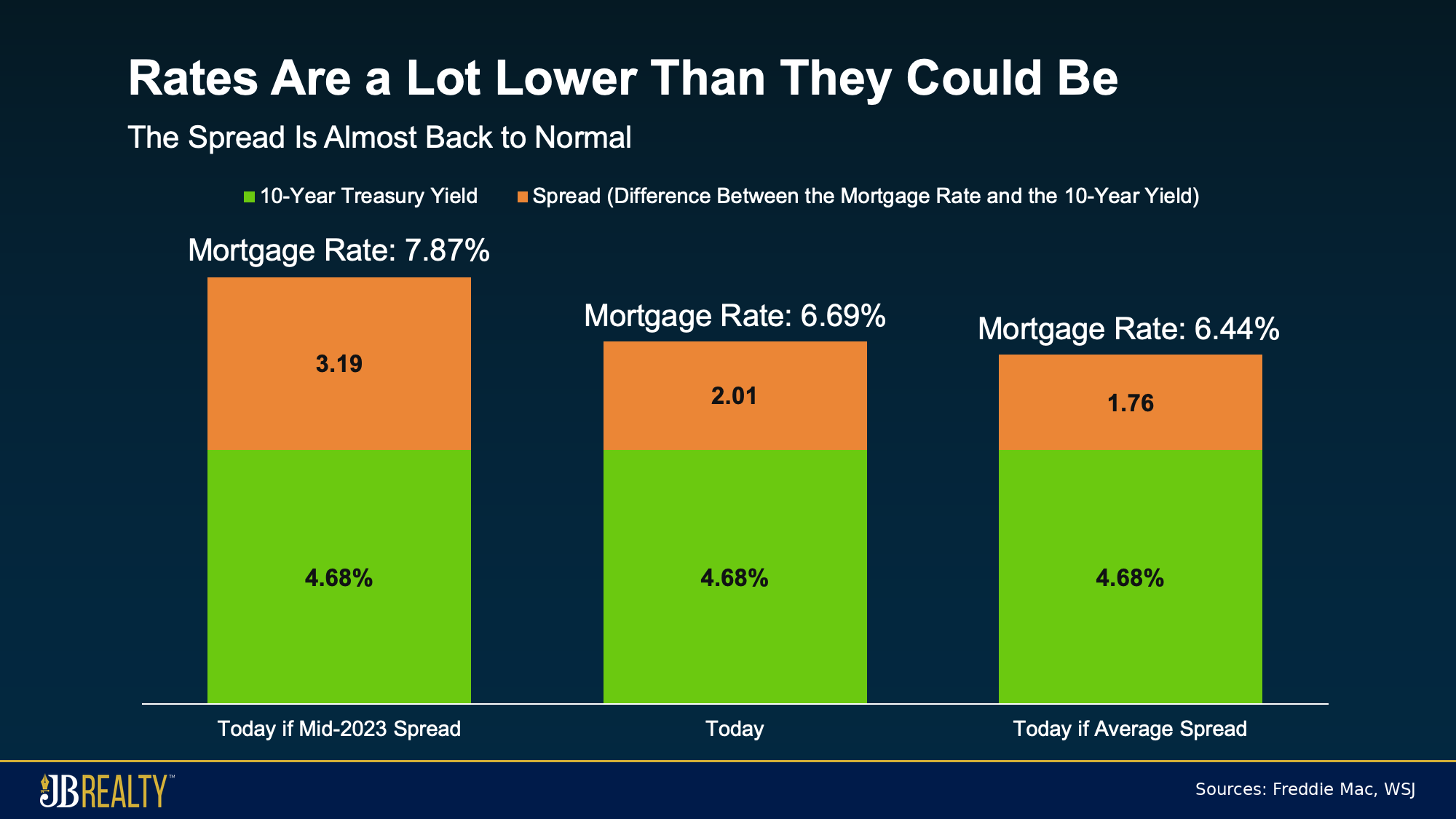
When the spread was above 3 percentage points, there was substantial room for mortgage rates to improve simply by bringing that gap closer to historical levels. With the spread now around 2 percentage points, much of that potential improvement has already occurred.
The historical benchmark used in the accompanying charts is approximately 1.76 percentage points. Moving from a spread near 2 points back to 1.76 would still help, but the difference is only around one-quarter of a percentage point.
That means mortgage rates could potentially improve somewhat even if Treasury yields stayed relatively stable. But spread normalization by itself has much less room to lower rates than it did when the gap was above 3 points.
For a much larger mortgage-rate decline, Treasury yields would likely need to move lower as well.
This is also why mortgage-rate predictions based only on Federal Reserve decisions can be misleading. The federal funds rate is a short-term benchmark. Mortgage rates respond to a broader bond market that reflects expectations about inflation, economic growth, government borrowing, monetary policy, investor demand, and other financial conditions.
For buyers in Riverview and other Tampa Bay communities, understanding the spread can help separate realistic possibilities from assumptions.
A buyer might reasonably hope rates improve. But delaying a purchase solely because the mortgage spread might narrow further puts a lot of weight on a relatively small remaining piece of the rate equation.
Instead, compare the complete financial picture of buying now with waiting.
That should include:
Those property-specific costs can vary significantly even between homes with similar prices. Buyers reviewing Riverview market data, for example, should still evaluate each property's taxes, insurance exposure, association fees, condition, and financing options individually.
The interest rate matters, but it is one part of the affordability calculation.
Another mistake is assuming there is one universal mortgage rate.
The national averages discussed here are benchmarks. The rate offered to an individual borrower can depend on credit, down payment, loan program, occupancy, property type, points, lender pricing, loan amount, and other underwriting factors.
Buyers should consider comparing multiple lenders and asking each lender to explain the rate, annual percentage rate, lender fees, discount points, mortgage insurance, and total cash needed to close.
Depending on the transaction and loan program, buyers may also be able to negotiate seller credits that can be applied toward allowable closing costs or rate-related expenses. A lender should confirm the specific limits and requirements before those terms are included in an offer.
Our mortgage rate forecast guide explains another part of the decision: why waiting for a specific future rate can create tradeoffs involving home prices, available inventory, competition, and negotiating leverage.
The mortgage spread is the difference between mortgage rates and a benchmark such as the 10-year Treasury yield. It reflects additional risks and costs associated with mortgage lending and mortgage-backed securities. The spread can widen or narrow as financial-market conditions change.
The Federal Reserve directly targets a short-term interest rate, while fixed mortgages are longer-term financial instruments. Mortgage rates are more closely connected with longer-term bond-market conditions, which is why the 10-year Treasury is commonly used as a benchmark.
Yes, mortgage rates could decline somewhat if the mortgage spread narrows further. But with the spread already much closer to its historical range, there is less room for that factor alone to create a large decline.
No. National mortgage-rate surveys provide useful benchmarks, but an individual borrower's rate can differ based on credit, down payment, loan type, points, property characteristics, lender pricing, and other factors. Compare actual Loan Estimates and discuss the details with qualified mortgage professionals.
That depends more on your finances, timeline, available homes, and current payment than on a specific rate prediction. If the payment works comfortably today, compare buying now against the potential benefits and risks of waiting rather than assuming substantially lower rates are guaranteed.
If you are considering a purchase, our Tampa Bay home-buying services can help you compare homes, property-specific ownership costs, available incentives, and negotiating options alongside the financing numbers from your lender.