A home’s price range can affect how quickly it sells, how buyers finance it, and how much competition it faces. It does not determine the outcome by itself. For Tampa Bay sellers, the useful question is not whether the entire market is strong or slow. It is how homes similar to yours are performing within the same location, property type, condition, and price range.
That distinction can reveal a seller leaning pocket inside a broader buyer leaning market, or the opposite. Your pricing strategy should begin with the alternatives your likely buyers can purchase instead of your home.
A Riverview single family home does not compete equally with every property in Hillsborough County. Its closest competition may include homes with similar square footage, age, condition, community fees, school assignments, and access to new construction.
The same principle applies to a St. Petersburg condo. Another unit with a similar price may not be a true comparable if its association fees, reserves, assessments, building age, insurance situation, view, or financing eligibility are materially different.
Price range is one part of this competitive set. Property type, condition, ownership costs, and available alternatives also affect buyer and seller leverage. That is why a broad market label cannot replace property specific analysis.
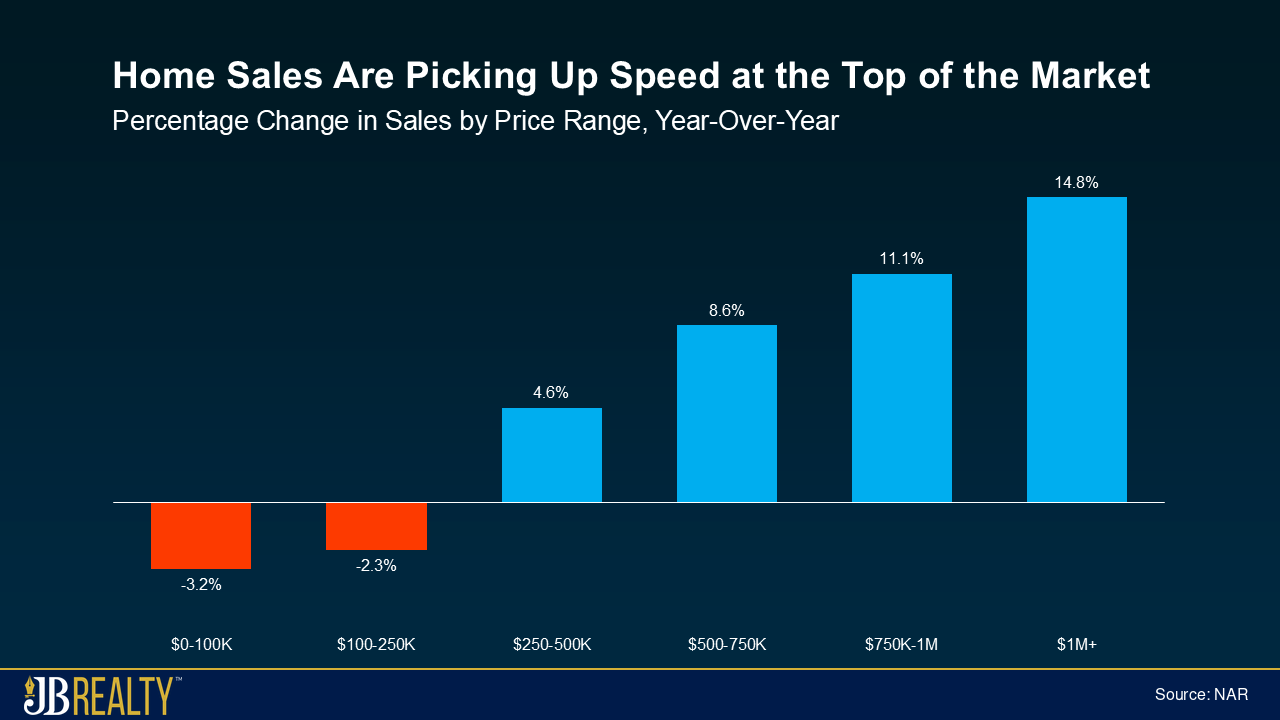
The national sales data supplied with this article shows a clear difference between price ranges. Sales declined 3.2% for homes below $100,000 and 2.3% for homes from $100,000 to $250,000. Sales increased 4.6% from $250,000 to $500,000, 8.6% from $500,000 to $750,000, 11.1% from $750,000 to $1 million, and 14.8% at $1 million or more.
One reason is that buyers at lower price points often depend more heavily on mortgage financing and manageable monthly payments. A change in rates, insurance, taxes, association fees, or expected repair costs can affect what they qualify for and what they are comfortable paying.
Higher priced buyers may have more equity, cash, or financial flexibility, although that does not make every expensive home easy to sell. The National Association of Realtors’ analysis of buyer sensitivity explains why borrowing costs can affect different groups unevenly.
The chart describes a national pattern, not a guaranteed result for an individual Tampa Bay property. A lower priced home with strong presentation and little direct competition can sell quickly, while an overpriced luxury home can remain available for months.
Luxury homes historically took longer to sell because they appealed to a smaller buyer pool. The supplied market time data shows that difference narrowing considerably. In 2013, the median gap was approximately 10 days. By May 2026, the figures were nearly equal at approximately 43 days for luxury homes and 42 days for starter homes.
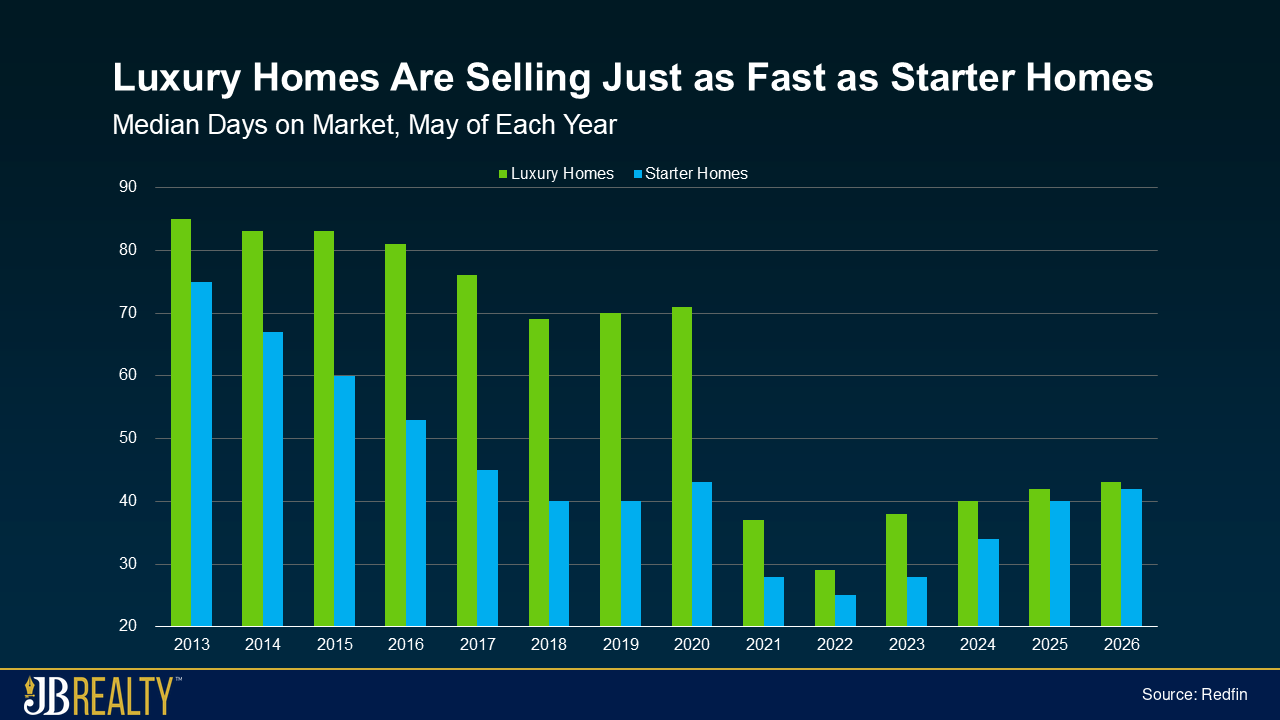
This does not mean every luxury listing will move as quickly as an entry level home. Unique design choices, deferred maintenance, an uncommon location, or a price unsupported by recent sales can still limit demand.
It does mean sellers should not assume a higher price automatically requires a much longer sale. Strong demand within the correct segment, accurate pricing, effective presentation, and limited competition can produce faster activity than a broad market headline suggests.
There is no single dollar amount that defines a starter home, move up home, or luxury home across Tampa Bay. The dividing lines change by community, property type, and the choices available to buyers.
Florida Realtors’ July 2026 housing report reported annual sales gains and declining inventory across both major residential property categories. That statewide direction provides useful context, but it cannot tell a seller how a particular home will perform.
A $500,000 home in Riverview may compete with newer subdivisions offering different financing incentives and community amenities. A similarly priced condo in St. Petersburg may compete based on association finances, monthly fees, assessments, building condition, parking, and location. The same price can therefore represent two very different buyer pools.
Florida ownership costs also affect how buyers view a listing. Estimated property taxes after purchase, homeowners insurance, possible flood insurance, roof age, HOA fees, community development district assessments, and condo assessments can all change the complete monthly cost. A competitively priced home can still face resistance if buyers discover expenses or property concerns they did not anticipate.
A reliable pricing strategy should examine four connected layers:
Search brackets also deserve attention. A buyer who limits a property search to $500,000 will not see a home listed at $505,000 in that search. Pricing slightly above a common threshold may reduce visibility, although pricing below one is not automatically the correct decision. The comparable sales and current competition should control the strategy.
Sellers can request a home value estimate to begin comparing recent sales and current listings. Our Tampa Bay home selling services connect that pricing analysis with preparation, presentation, marketing, offer review, and negotiation.
Some recent data shows stronger activity at higher price points, but that does not guarantee a faster sale for every expensive property. Market time still depends on location, condition, presentation, direct competition, and whether buyers consider the price justified.
There is no universal price that defines luxury throughout Tampa Bay. The category is relative to the local market, so a property’s community, features, lot, view, construction quality, and nearby competition should be considered along with its price.
That approach can help a property appear in searches capped at the round number. It should only be used when the resulting price is supported by comparable sales, current competition, and the seller’s strategy.
The asking price may still be high compared with nearby alternatives, or buyers may be concerned about condition, repairs, insurance, financing, or ownership costs. Listing presentation and competition from new construction can also affect activity.
Review online engagement, showing activity, buyer feedback, new competing listings, and recent pending sales. Those signals can help determine whether the property needs a pricing adjustment, presentation improvement, additional information, or more time.
Ask JB Realty to compare your home with the active, pending, and recently sold properties in its exact market segment, then build a property specific pricing and launch strategy.