Higher mortgage rates can shrink buyers’ budgets and make builder financing incentives more influential. Tampa Bay home sellers can respond by pricing against current alternatives and choosing terms that address the buyer’s actual cost constraint. A useful selling plan starts with local competition and your net proceeds, then compares price reductions, closing-cost assistance, and lender-approved rate buydowns.
Before offering an incentive, identify the obstacle. Is the home priced above comparable alternatives, does the buyer need help with closing expenses, or is the monthly payment too high? Each problem calls for a different response, and a concession cannot make unsupported pricing disappear.
Consider a hypothetical $425,000 offer with a $10,000 seller credit. Subtracting that credit leaves $415,000 before the mortgage payoff and other seller expenses. A $415,000 offer without a credit starts at the same amount, although the final proceeds can differ because some transaction costs depend on price.
The buyer experiences those choices differently. A lower price may reduce the amount financed, while a credit can cover eligible closing expenses or lender-approved financing costs. Have the buyer’s lender compare both structures before assuming that the same seller cost produces the same buyer benefit.
Fannie Mae’s seller-contribution rules limit financing concessions based on the transaction and available eligible costs. Other loan programs have their own requirements. Confirm the usable amount, permitted purpose, and appraisal implications before agreeing to a credit or advertising a specific financing benefit.
Freddie Mac’s weekly mortgage survey reported a 7.28% average for 30-year fixed-rate mortgages on October 1, 2026, up from 7.03% the previous week. That national benchmark helps explain affordability pressure, but an individual buyer’s quote depends on their qualifications, loan, property, and lender.
For a simple illustration, a $360,000 loan over 30 years would require about $2,395 monthly in principal and interest at 7%, compared with $2,158 at 6%. The roughly $237 difference excludes taxes, insurance, mortgage insurance, and other ownership expenses. These hypothetical rates are calculation assumptions, not loan offers.
A seller-funded permanent rate buydown generally pays discount points to obtain a lower mortgage interest rate. A temporary buydown instead subsidizes the buyer’s payments for a limited period while the loan’s contractual interest rate, called the note rate, remains unchanged. Ask the lender to show the upfront cost and payment schedule for each available option.
For loans following Fannie Mae’s temporary-buydown rules, the lender qualifies the buyer using the full note rate. The initial subsidized payment therefore does not become the qualification payment. A temporary buydown can help early cash flow, but the buyer must understand the payment after that assistance ends.
Realtor.com’s August 2026 national analysis found that 18.8% of new-construction listings on its platform advertised a buyer incentive, while 13.8% advertised reduced rates. Other categories included flexible incentive funds, closing-cost assistance, upgrades, and appliances. Some listings advertise several incentives, so the categories overlap.
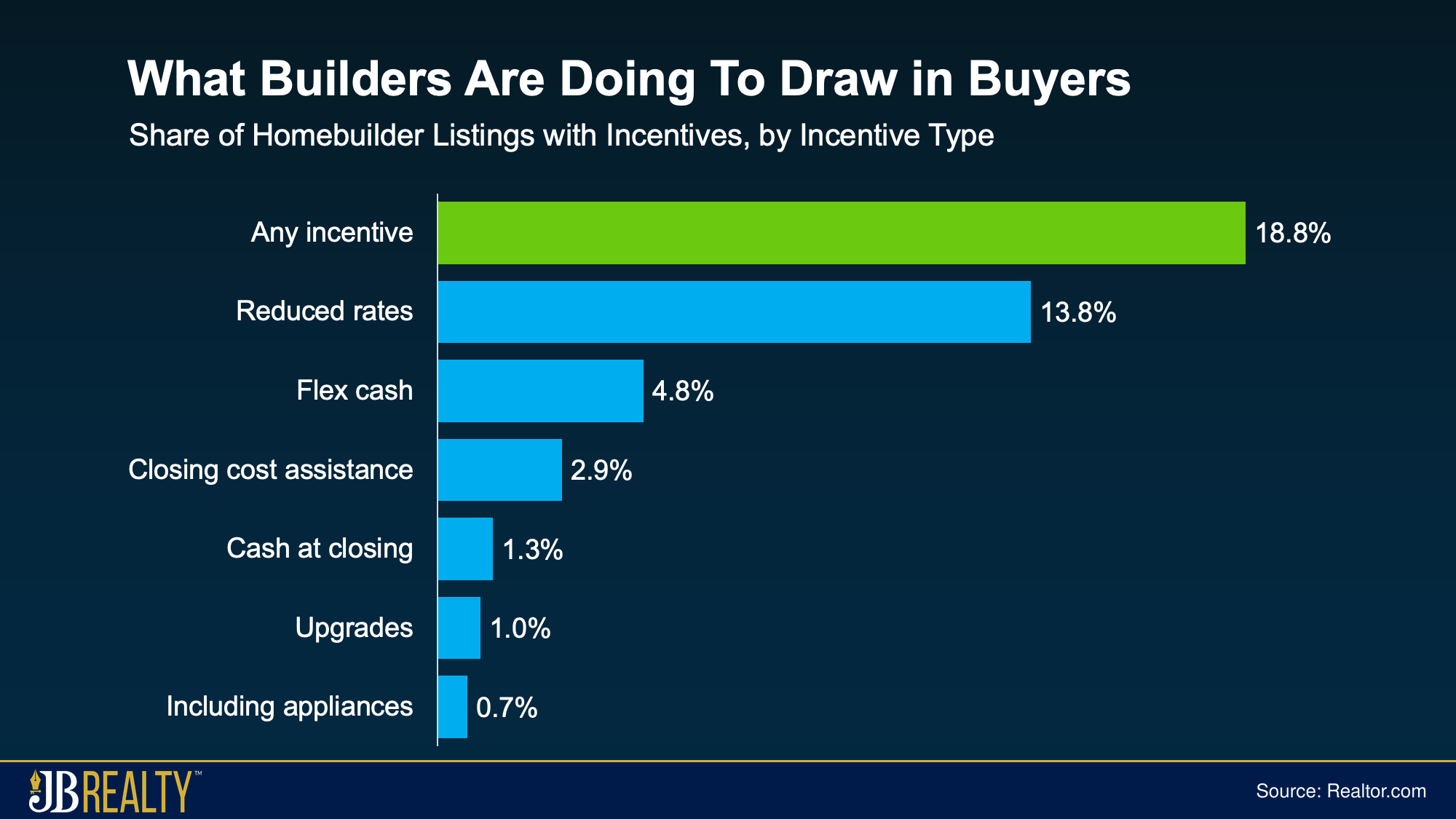
Those figures describe advertised listings on one platform, not every builder’s current programs or the incentive share in Tampa Bay. Use them as a reason to investigate the actual offer competing with your home. An advertised rate deserves a review of its duration, fees, eligibility requirements, and any preferred-lender conditions.
If a buyer is comparing a Riverview resale with a new home in Ruskin, match the home type, living area, lot, included features, and closing timeline. Request the complete price for the specific new home rather than comparing your house with a model’s starting price. Our guide to new-construction costs and incentives explains the details that can change that comparison.
Florida ownership costs belong in the same review. Obtain property-specific insurance information, verify tax estimates with the county property appraiser, and check current HOA dues and any community development district, or CDD, assessments. For flood information, use FEMA’s official resources and a licensed insurance professional. A lower advertised mortgage payment does not settle the complete cost comparison.
Your home can compete through features and terms as well as financing. Document roof and HVAC ages, completed repairs, included appliances, and improvements that buyers can verify. Existing fencing, landscaping, or window coverings may reduce move-in purchases when those items are included and useful to the buyer.
Explain practical differences such as lot dimensions, available community amenities, and a closing date that fits the buyer’s schedule. Keep claims specific to the property instead of making broad statements about neighborhood quality. Clear information gives buyers a firmer basis for comparing an existing home with a builder’s offer.
Review your position as competing prices and financing terms change. If buyers consistently identify price, condition, or carrying costs as the obstacle, address that issue directly. A credit may help a workable deal, while a price correction may be more appropriate when comparable homes offer stronger value.
They are a reason to reassess buyer affordability and competing homes. The appropriate response depends on comparable sales, current alternatives, your home’s condition, and buyer feedback. A price adjustment may help when the asking price is the obstacle; a targeted credit may address a different constraint.
Yes, when the buyer’s loan program and lender allow it. The contribution must fit applicable limits and be documented in the transaction. Ask the lender to confirm the cost and terms before promising a particular rate or payment.
A credit may be more useful when the buyer needs eligible upfront expenses covered. A price reduction can lower the amount financed and address a pricing concern. Compare the lender’s calculations and your estimated proceeds to choose the structure that fits the offer.
No. Builder financing may involve terms, lender arrangements, or temporary subsidies that cannot be reproduced at the same cost on your sale. Compare the buyer’s complete alternatives and decide which price, credit, repair, or timing terms you can reasonably offer.
Under Fannie Mae’s rules, qualification uses the full note rate rather than the subsidized initial payment. Other programs should be checked with the buyer’s lender. Early payment assistance should not be treated as proof that the buyer qualifies for the loan.
Through our Tampa Bay seller representation, we help compare your home with current alternatives and evaluate offer terms. Ask JB Realty to review nearby resale and builder competition, your likely selling range, and the estimated proceeds from a price change or buyer credit before choosing an incentive.