Many Tampa Bay buyers begin their home search with a detached single-family home in mind. When prices or monthly payments exceed the budget, they may assume homeownership is no longer realistic.
Expanding the search to include condos & townhomes can create additional opportunities. These properties often have lower purchase prices, different maintenance responsibilities and access to locations where detached homes may cost considerably more.
They are not the right choice for every buyer, but they deserve a careful look before deciding the market has nothing affordable to offer.
A condo or townhome can provide many of the primary benefits of homeownership. Buyers can build equity, establish a stable monthly housing plan and personalize their living space within the community’s rules.
The tradeoff is that ownership usually involves shared walls, association fees and restrictions that may not apply to a detached home. Buyers should compare the complete ownership experience rather than focusing only on the lower asking price.
For first-time buyers, downsizers and buyers who prioritize location over yard space, the benefits can outweigh those limitations. The key is understanding exactly what is included in the purchase and what responsibilities remain with the owner.
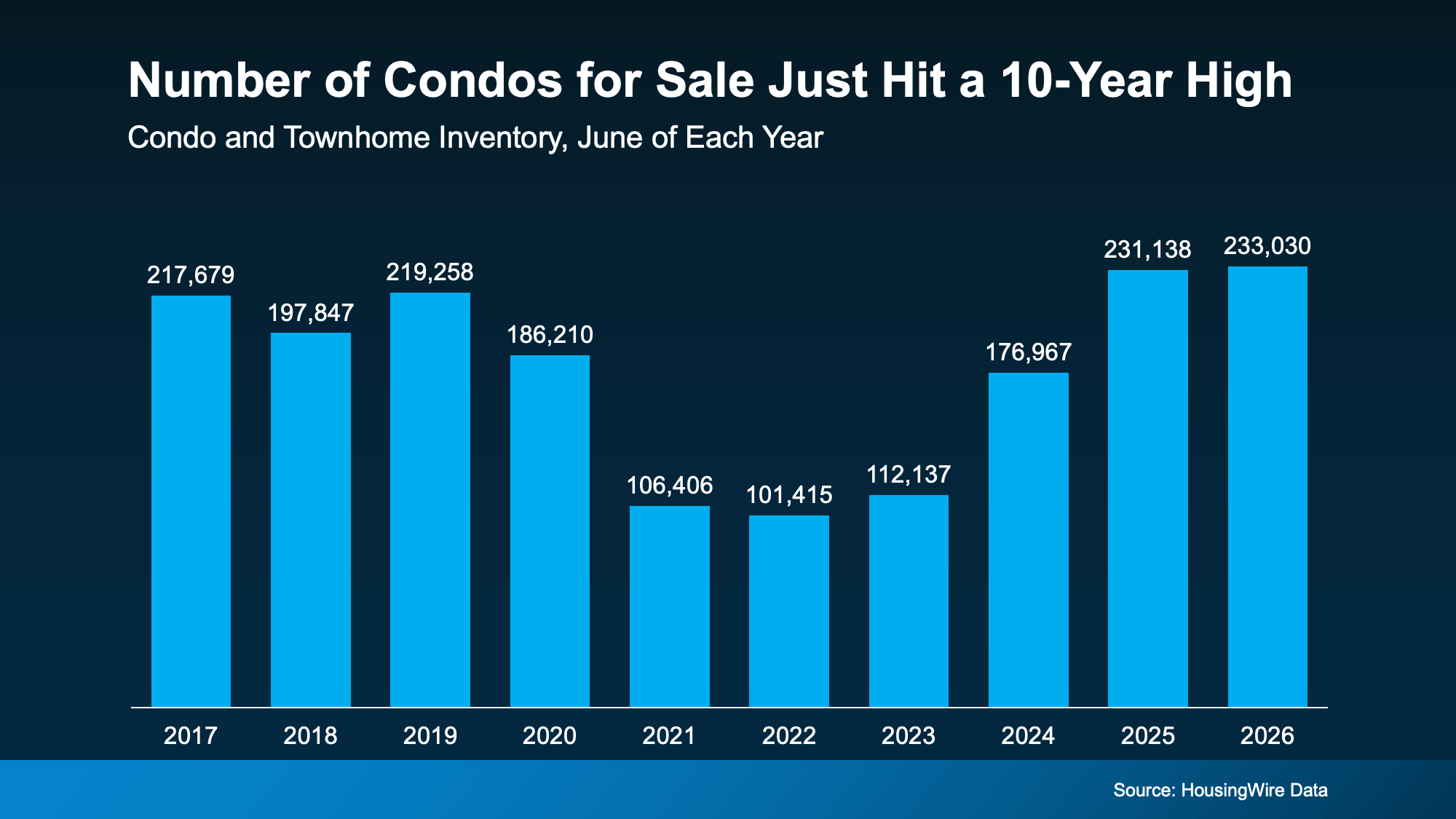
Nationally, 233,030 condos & townhomes were available for sale in June 2026. That was the highest June total in at least 10 years and more than double the number available in 2022.
A wider selection can give buyers more time to compare properties instead of feeling pressured to purchase the first acceptable option. It can also create stronger negotiating opportunities when several similar units are competing for the same group of buyers.
The 10-year comparison puts the growth in available choices into perspective.
Local availability will vary throughout Hillsborough & Pinellas counties. The selection of Tampa Bay condos for sale may look very different from the selection of townhomes available in Brandon, Riverview, St. Petersburg, Clearwater or Largo.
That is why buyers should search by both property type and location. Removing condos or townhomes from the search can unintentionally eliminate properties that meet the buyer’s space, budget and neighborhood goals.
The national median condo price was $380,000 in June, compared with $446,400 for a single-family home. That represents a difference of $66,400.
A lower purchase price may reduce the down payment, loan balance and monthly principal & interest payment. It may also help a buyer remain within a preferred area instead of moving farther away to find a detached home.
The side-by-side price comparison helps explain why some buyers are widening their search.

The purchase price is only one part of affordability. A condo with a higher monthly association fee could have a similar total payment to a more expensive townhome with a lower fee.
Buyers should compare the complete monthly cost before deciding which property is more affordable. That includes principal & interest, property taxes, homeowners insurance, flood insurance when applicable, association fees and expected maintenance.
The exterior appearance does not always determine the legal ownership structure. A townhome describes a style of construction, but the property may be owned fee simple or may legally be part of a condominium.
With a traditional detached home, the owner generally owns the structure and the land beneath it. The owner is also usually responsible for the roof, exterior, landscaping and other maintenance.
With a fee-simple townhome, the buyer may own the structure and the lot. The association may maintain certain exterior areas, landscaping or shared features, but the exact responsibilities depend on the governing documents.
With a condominium, the buyer generally owns the unit according to boundaries defined in the declaration. The buyer also receives an interest in common elements such as the land, hallways, roof, exterior, amenities and other shared areas.
These differences affect insurance, maintenance, financing and future repair obligations. Buyers should review the deed, declaration, association documents and property disclosures rather than relying only on how the home is described in the listing.
Association fees are not automatically an added expense with no value. They may pay for exterior maintenance, landscaping, water, sewer, trash service, building insurance, amenities, security and reserve funding.
The amount included varies substantially between communities. One association may cover only basic common-area maintenance, while another may include the roof, exterior, cable, internet, water and recreational facilities.
Buyers should obtain a written breakdown of what the fee covers. They should also confirm which repairs remain the unit owner’s responsibility and whether the fee is expected to increase.
A lower monthly fee is not always better. An association that collects too little may lack the reserves necessary for major future repairs, which can lead to special assessments.
Buying a Florida condo requires careful review of the association and the building, not just the individual unit. A renovated kitchen does not offset serious financial or structural concerns within the overall community.
Buyers should review the association budget, reserve information, recent financial statements, meeting minutes and current or proposed special assessments. These documents can reveal upcoming projects, disputes, deferred maintenance and changes that may affect future costs.
For buildings subject to Florida’s milestone inspection requirements, buyers should review the available inspection reports, recommended repairs and plans for funding the work. Engineering reports and notices involving the roof, balconies, elevators, plumbing, electrical systems or building structure should also be evaluated.
The association’s master insurance coverage is another important consideration. Buyers should confirm what the association insures, what the unit owner must insure and whether recent storms have created unresolved claims or repair obligations.
Association rules can affect how a buyer uses and eventually sells the property. Common restrictions may involve pets, leasing, vehicles, parking, renovations, guests and minimum ownership periods before renting.
Some communities are age restricted, while others limit the number of units that can be rented at one time. A buyer who expects to turn the property into a rental later should confirm that the plan is permitted before purchasing.
Approval procedures also vary. Some associations require applications, interviews, fees or additional financial documentation before a buyer can complete the purchase.
Buyers should read the actual governing documents. Verbal explanations from an owner, resident or listing agent should not replace a review of the recorded restrictions and current association policies.
Financing a condo can involve more than qualifying the buyer. The lender may also need to review the condominium project, association finances, insurance coverage, litigation and other community information.
A buyer who is preapproved for a detached home may not automatically qualify to purchase every condo within the same price range. The property must also meet the lender’s requirements.
This is especially important for buyers using FHA, VA or lower down payment conventional financing. The lender should review the community early so a financing concern does not appear after the buyer has spent money on inspections and an appraisal.
Townhome financing may be more straightforward when the property is fee simple, but buyers should still provide the association documents and ownership details to the lender. The legal classification matters more than the architectural style.
Buyers searching for Hillsborough County townhomes for sale may find options in Tampa, Temple Terrace, Town ’n’ Country, Brandon, Riverview and surrounding communities. These areas can offer different combinations of commute time, newer construction, association amenities and monthly fees.
Pinellas County condos for sale are available throughout St. Petersburg, Clearwater, Largo, Seminole, Dunedin, Palm Harbor and Gulf Coast communities. Buyers in Pinellas should pay particularly close attention to flood exposure, evacuation zones, building age, insurance and storm-related repairs.
A condo near Downtown St. Petersburg may offer walkability and amenities, while a townhome in Riverview may provide more interior space and an attached garage. Neither is automatically the better purchase.
The right choice depends on the buyer’s budget, lifestyle, commute, maintenance preferences and expected length of ownership.
A property should meet the buyer’s current needs, but future marketability also matters. Association finances, fees, restrictions and building condition can affect both resale demand and financing options for the next buyer.
Units with functional layouts, reasonable fees, adequate parking and well-maintained common areas may appeal to a broader group of buyers. Properties with unresolved assessments, unusually restrictive rules or substantial deferred maintenance may be more difficult to sell.
Buyers should also consider whether the property provides enough space for their likely needs over the next several years. Purchasing a property that becomes unsuitable too quickly can reduce the financial benefit of the lower entry price.
Condos & townhomes can work well for first-time buyers who want a lower purchase price and fewer exterior maintenance responsibilities. They may also appeal to downsizers who no longer need a large house or yard.
Busy professionals may prefer communities where landscaping and exterior upkeep are handled by the association. Buyers who want access to pools, fitness centers, gated entrances or other shared amenities may also find value in this property type.
A townhome may be the better fit for someone who wants additional space, a garage and greater separation from neighbors. A condo may work better for someone who prioritizes location, amenities and reduced maintenance.
The decision should be based on the individual property, association and total monthly cost rather than a general assumption that all condos or all townhomes are alike.
Buyers who feel priced out of detached homes may still have realistic paths to ownership. Condos & townhomes can offer lower purchase prices, more available choices and access to desirable Tampa Bay locations.
The lower price must be weighed against association fees, restrictions, insurance, assessments and the condition of the entire community. Careful review of the association documents and ownership structure is essential before making an offer.
We help buyers compare Tampa Bay condos for sale, townhomes and detached homes throughout Hillsborough & Pinellas counties. The goal is to identify the property type that fits the buyer’s budget, lifestyle and long-term plans without overlooking expenses that could affect affordability after closing.