Buying a home near a data center is not automatically a bad investment, and current national evidence does not show a consistent price penalty. It still deserves careful, property specific review. A buyer should verify the facility’s status, distance, site plan, noise sources, utility infrastructure, and construction timeline before deciding whether the home and its price make sense.
For Tampa Bay buyers, official planning records and conditions at the actual property provide more useful information than rumors or a national average.
Data centers contain computer equipment used for cloud services, artificial intelligence, digital storage, streaming, and other online activity. They vary considerably in size. A small facility inside an existing commercial building may have little in common with a large campus requiring new substations, transmission equipment, cooling systems, generators, and utility improvements.
The supplied chart counts U.S. ZIP codes containing a large data center of at least 50 megawatts. That total rose from about a dozen in 2015 to more than 100 by the first half of 2026, with additional growth projected by the end of the year.
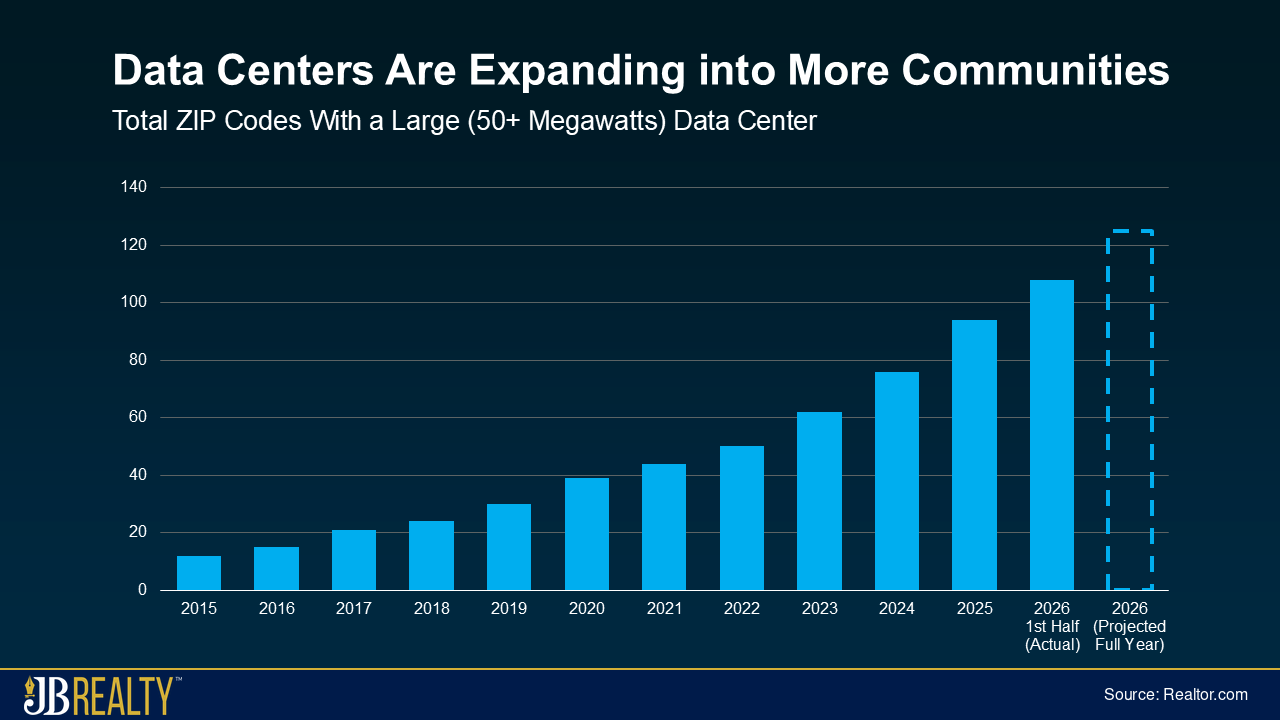
As expansion reaches more communities, buyers are increasingly likely to encounter an operating facility or hear about one that has been proposed. The correct response is to investigate the specific project rather than assuming every data center creates the same advantages or concerns.
The national research behind this topic compared 43 ZIP codes where large data centers opened between 2019 and 2025 with similar ZIP codes that did not receive one. The communities were matched using factors such as prior home prices and population density. Researchers did not find a statistically meaningful difference in subsequent home price performance.
That finding is useful, but it does not prove that every nearby property will be unaffected. ZIP codes can cover large areas, and the experience of a home next to a facility may differ from one several miles away. A ZIP code average also cannot account for every difference in noise, views, buffers, utility equipment, road access, construction, or buyer perception.
The research should therefore be treated as evidence against an automatic price penalty, not as a guarantee about an individual home’s future value.
A buyer should first determine whether the facility is operating, under construction, approved, proposed, or merely discussed. Those stages carry different levels of certainty.
Investigate:
For properties in Riverview, Brandon, and other unincorporated parts of Hillsborough County, the official Hillsborough County Map Viewer provides zoning, future land use, flood information, and other parcel data. The map is a useful starting point, but buyers should confirm important findings with county zoning or planning staff.
Florida’s 2026 data center law, effective July 1, preserves local authority over comprehensive planning and land development regulations involving large load customers. It also establishes requirements involving utility tariffs and water permitting for certain large facilities. The law does not replace local research or guarantee a particular effect on residential utility bills.
Distance alone does not determine whether a data center will affect daily life. Buildings, vegetation, elevation, walls, roads, and the location of mechanical equipment can change what a homeowner sees or hears.
Visit the property more than once and, when practical, at different times. Listen for cooling equipment, generator testing, traffic, and nearby utility infrastructure. If the facility is not operating yet, review the approved plans instead of assuming current conditions will remain unchanged.
Also consider:
Data center development may contribute to infrastructure investment, tax revenue, or economic activity, but buyers should not assume those potential benefits will directly improve a particular neighborhood or home.
There is no universal distance that makes a home too close to a data center. One buyer may accept a visible commercial facility in exchange for a lower price or preferred location. Another may place greater value on quiet surroundings and limited nearby development.
Review comparable sales, current listings, price changes, and market time for homes with similar surroundings. If a property has direct exposure to a facility or related infrastructure, compare it with homes that share that exposure when possible.
A lower price can compensate for a concern, but only if the discount reasonably reflects the property and likely future buyer pool. Our Tampa Bay buyer representation can help buyers compare the home, nearby development, resale considerations, and available alternatives before deciding what terms to offer.
A seller near an operating or proposed data center should gather reliable information before listing. Helpful records may include the facility location, approval status, site plan, expected construction timeline, public hearing documents, and information about buffers or infrastructure.
Avoid promising that the facility will raise values or dismissing buyer concerns without evidence. Disclosure obligations depend on the facts and applicable law, so legal questions should be directed to a qualified Florida attorney.
A home value review should compare the property with recent sales and current competition while considering visibility, noise, construction, and buyer feedback. JB Realty’s Tampa Bay home selling services can connect that analysis with pricing, presentation, marketing, and offer review.
Not automatically. National research has not found a consistent price decline across ZIP codes where large data centers opened. The effect on a particular home may still depend on proximity, visibility, noise, construction, infrastructure, and buyer perception.
There is no universal distance because facilities and surrounding properties differ. Evaluate conditions from the home, review the site plan, and determine whether buildings, equipment, lighting, traffic, or utility infrastructure could affect daily use or resale.
Search the property and surrounding parcels through the applicable city or county planning system. Review zoning, future land use, application numbers, public hearing notices, permit records, and meeting agendas, then confirm the information with local planning staff.
Electric rates depend on the utility, regulatory decisions, infrastructure costs, fuel expenses, and multiple other factors. Florida has added requirements addressing utility service for certain large load customers, but buyers should not treat that as a guarantee that residential rates will remain unchanged.
Provide verified information from public records and avoid speculation about property values, utility costs, or future development. Review comparable homes with similar surroundings and consult a qualified Florida attorney if a question involves disclosure obligations.
Ask JB Realty to help compare the property, nearby land use records, direct competition, and resale considerations before buying a Tampa Bay home near a proposed or operating data center.